The Sacred Flourishing of the Divine Mother: Retelling the Mystic Story of the Ambubachi Festival
Ambubachi festival holds the highest reverence within the ambit of Sanatana Dharma by celebrating the revered cosmic cycle of Mother Earth. The Kamakhya Peetha of Guwahati is the epicentre of this holy festival, marking the awakening of the Divine Mother as the embodiment of Goddess Shakti.
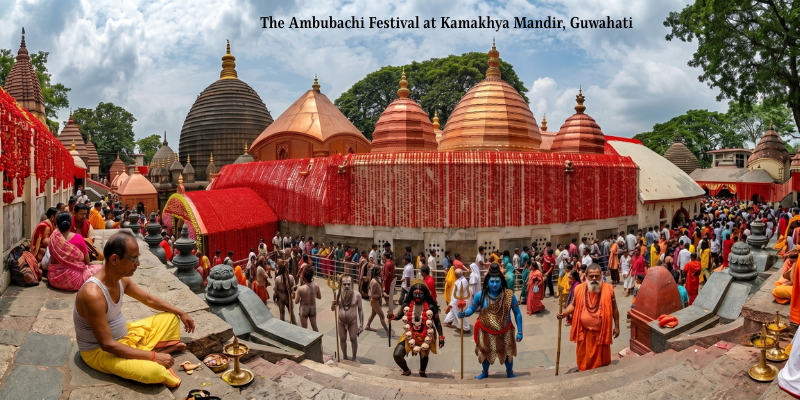
Amidst the mysticism of eternal Bharatvarsha, where each river is the nurturing mother and each mountain is the meditation of the sage, the rhythm of Prakriti is not just watched but revered with devotion. Of all the countless spiritual rites in the Hindu calendar, there is nothing more magnificent and unmatched than the glorious Ambubachi Festival. This is a period during which the veil between the mortal and cosmic divine becomes so delicately thin, allowing true devotees to behold the awe-inspiring phenomenon of the renewal of the earth’s fertile womb.
While the modern world tends to envelop the natural physiological processes of femininity in darkness, the spirituality of ancient India holds this sacred cycle of fertility at the pinnacle of cosmological reverence. Journey with us through the spiritual and ritualistic aspects of this grand celebration. Discover the myths of scripture and boundless spirituality surrounding the glorious veneration of the sacred feminine.
What is Ambubachi? The Awakening of Cosmic Motherhood
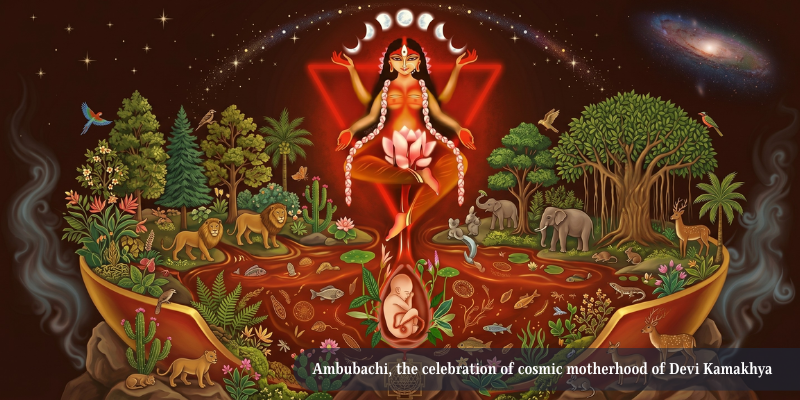
In order to understand the true meaning of the festival, one needs to go beyond the mere materialistic vision and enter into the depths of understanding the Shakta tradition. This is the grand annual festival of the Ritu Chakra (Cycle of Renewal) which signifies the process of cosmic motherhood of Devi Kamakhya.
Located on the mystic Nilachal hills, Devi Kamakhya is not represented by an idol or statue made of either stone or metal. In the contrary, the deity manifests herself through the natural underground stream running from the bedrock fissure, which represents the Divine Yoni (the cosmic female generative organ).
- The Celebration of Cosmic Fertility: It denotes the sacred season in which Mother Earth is ritually purified and renewed annually. It is the divine awakening of her regenerative powers, as she is prepared to nurture and nourish her progeny and support the entire creation in the upcoming year.
- The Elimination of Worldly Taboos: There is a beautiful paradox about this ritual in terms of spirituality as the biological fertility process which is generally frowned upon in worldly society receives the most reverence as a form of worship. It acts as an eternal reminder that all existence emerges out of the womb that bleeds, feeding and liberating creation.
- The Union of Subtle Energies: It is a season of deep introspection and repose on Earth. No activity occurs on Earth at all; only subtle energy (Prana) flows in order to renew and rejuvenate itself.
When is Ambubachi Celebrated?
This spectacular spiritual event does not depend on any random date picked from an artificial Gregorian calendar, but rather takes its cue from the heavenly and divine celestial timing according to Vedic Hindu astrology (Jyotisha). It comes down to bless humanity every year during the month of June, which corresponds to Ashadha on the Hindu lunar calendar.
- The Astrological Alignment: The divine festival starts exactly when the Sun (Surya) passes through Mithuna Rashi (the Gemini constellation), coming under the influence of Mrigashira Nakshatra. It is this particular star alignment which decides when the gates of heaven would be opened.
- The Arrival of the Monsoons: This particular astrological phenomenon is also the time when monsoon rains drench the Brahmaputra valley. These life-sustaining rains bring the swollen rivers and turn the earth green symbolizing the fertile condition of the Goddess.
- The Duration: This festival lasts for a period of exactly four days. For the first three days, the Mother Goddess is believed to go through her divine process of rejuvenation and is kept in undisturbed sleep. On the fourth day, a great purification takes place and the gates of heaven come down in all their glory on earth.
How is Ambubachi Celebrated?
Contrasting the boisterous and celebratory festivities that are witnessed in popular festivals such as Diwali and Holi, the festival of Ambubachi requires one to maintain utmost silence. It is a highly introspective, strict, and silent celebration of the goddess. On the days of Ambubachi Festival, people remain very devout and austere.
- The Closing of the Sanctum (Garbhagriha): At the beginning of the festival, the main silver door of the temple is securely shut. For three successive days, there is neither worship nor aarti or ringing of bells or chanting from holy texts in the inner sanctum. Complete rest is provided to the Mother.
- The Calming of the Earth: Across the land, devotees engage in complete abstinence from their bodily activities. The Mother being in her process of rejuvenation, no one practices agriculture and farmers do not till the earth, dig or sow anything out of extreme devotion for their resting Mother.
- Personal Austerities (Tapasya): Ascetics, widows, and devout followers keep extreme fasts. Hot food is not prepared, but the people take only fresh fruit and raw milk and other uncooked foods as an offering to the cooling fires of earth.
- The Divine Blessing (Maha Darshan): On the fourth day morning, the priests of the temple bathe and purify the Goddess. After performing this secret ceremony, the doors of the temple are flung wide open and the millions of devotees flock to receive the blessings of the divine Mother.
Why Ambubachi Is the Greatest Tantrik Sadhana Festival?
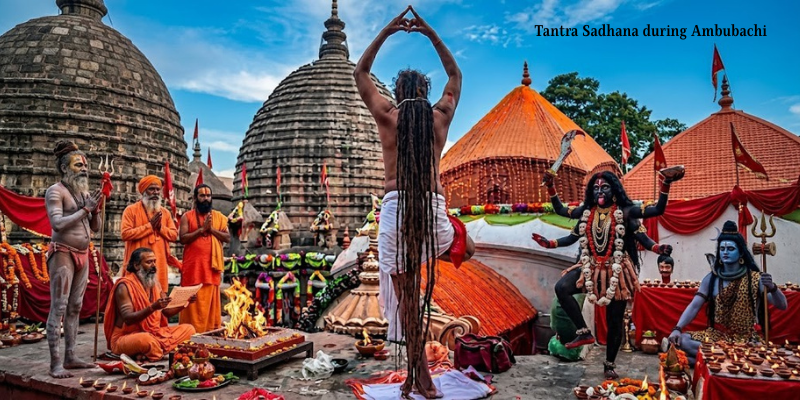
This particular festival acts as the gravitational focal point of the secret world of Tantra Sadhana. For those who practice mysticism like Aghoris, Bauls, and even mysterious Sadhus who operate in the periphery of society, this festival marks the spiritual peak of their existence.
Tantra is the art of harnessing and mastering the energy of the universe. At this particular point in time, the barriers between worlds disappear, and spirituality becomes exponentially more effective.
- Exponential Flow of Telluric Energies (Shakti): For the three days of the festival, the Earth pulsates with tremendous amounts of energy that is primal in nature. Meditating on the holy mountains for this period confers spiritual rewards which otherwise cannot be achieved by practicing severe penances in the Himalayas.
- The Awakening of Kundalini Shakti: Maa Kamakhya is well-known as the ultimate point of the Earth’s concentration of Kundalini energy. Devotees come together here to activate and channelize this highly potent cosmic energy for their own Kundalini Shakti—the sleeping energy coiled at the base of the spine of humans.
- Vamachara Practices: Several Tantric cults practice Vamachara—left-handed Tantrism—during this period. They perform clandestine rituals in the middle of the night in the ancient crematoriums and dense forest areas surrounding the sacred hills, interacting directly with their ferocious manifestations of the Divine Mother.
- Occult Transmission of Teachings (Diksha): It is one of the few periods during which the sequestered occult sages come out of their cave-like abodes. This festival is like an enormous cosmic school wherein powerful initiations into esoteric mantras and teachings are conducted from Guru to deserving disciple.
5 Unique Rituals Performed During Ambubachi
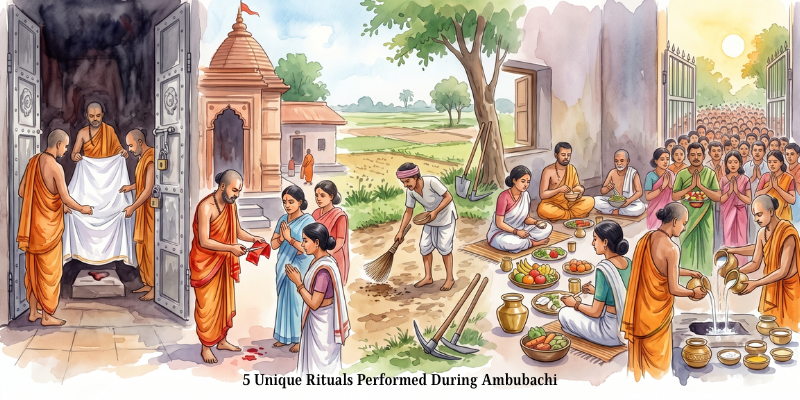
The practices carried out during this holy time are an interesting mixture of deep symbolism and firm belief. Here are 5 of the most unique rituals practiced during this holy period:
1. The Shrouding of the Womb of the Goddess
In the days preceding the festival, prior to sealing of the temple, the high priests will enter the Garbhagriha.
- A completely new piece of pure white silk cloth is draped over the crevice of stone which symbolizes the Mother Goddess.
- Then the heavy silver doors of the sanctum are closed on the outside, locking them shut. This ritual denotes giving the Mother total privacy, reverence, and the much-needed rest.
2. Blessing of the Sacred Red Cloth (Rakta Bastra)
The Rakta Bastra or Angodak blessing is undoubtedly the most coveted one within the whole Hindu diaspora worldwide.
- On the opening of the doors of the temple on the fourth day, the white silk cloth on which the deity rested would amazingly have blood-like divine substance all over its surface.
- Small pieces of this sacred red cloth are handed out to millions of devotees who believe that it has the power to keep away all the negative forces, heal diseases, and bestow prosperity.
3. Absolute Prohibition Against Any Interference With Earth
In respect of the sacred rebirth of Mother Earth, there exists a very strict ban against disturbing or damaging the Earth.
- The activity of farming, digging, ploughing, or planting must be totally prohibited within any of the areas surrounding the locality.
- It is often a common practice within many households that sweeping with a rough brush be done very carefully so as not to harm Mother Earth in any way during her sensitive phase.
4. The Austerity of ‘Phal-Ahaar‘ (The Fruit Diet)
The devotees follow an austere regime in their food intake, referred to as ‘Phal Ahaar’.
- Since it involves igniting the fire, which is an agitative activity (Agni Tattva), a lot of devotees choose not to cook at all during those three days.
- During this time, they subsist only on a cool diet consisting of fruits, raw milk, root vegetables, and holy water.
5. Grand Purification through Bathing Ceremony (Maha Snan)
At the dawn of the fourth day, before the common people can be permitted entry for Darshan, an extremely confidential and ornate bathing ceremony is performed by the high priests.
- The sacred stone crevice is purified with water from the sacred rivers, along with milk, curds, honey, and ghee (Panchamrita).
- It is only after the appeasing, purification, and adorning of the Goddess in new silk robes and flowers that the gates of the temple are opened to the masses.
Tragic Romance of Cosmos: The Story of Ambubachi
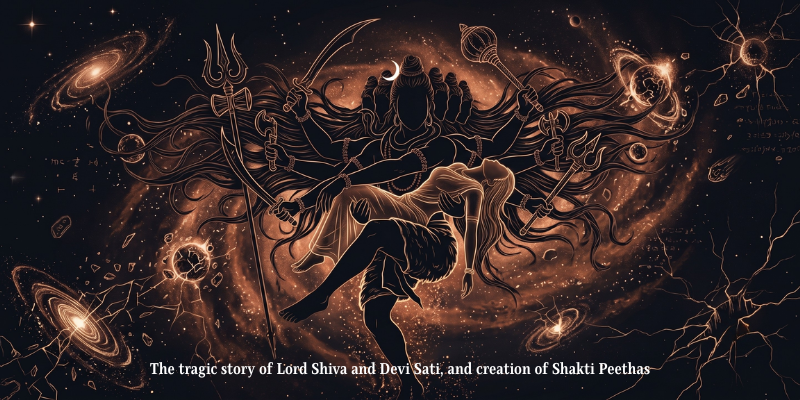
The mythology behind this festival traces its origins to one of the most tragic and profound legends contained in the Puranas—the tragic romance of Lord Shiva and his wife Devi Sati. According to the legends, this story changed the course of the universe forever.
- The Arrogance of Daksha: Devi Sati, the human embodiment of the mighty Goddess Shakti, chose to marry Lord Shiva, the fierce and untamed ash-covered god, despite the strong objections from her proud and aristocratic father, Prajapati Daksha.
- The Great Sacrifice: In the course of conducting a great yajna (a sacred fire ritual), Prajapati Daksha had invited every deity except Shiva and his wife Sati. Overcome by this great insult to her husband Shiva, Sati took her life by jumping into the flames of the ritual.
- Tandava Nritya – The Dance of Annihilation: Unable to bear his grief and uncontrollable wrath towards Brahma, Lord Shiva transformed himself into his fearsome Virabhadra avatar and shattered the entire yagna with his ferocious actions. Shiva picked up the body of Sati and began the Tandava dance of destruction and demolition, which placed the entire universe on the verge of total annihilation.
- The Creation of the Shakti Peethas: In order to protect creation from the uncontrollable and blind grief of Lord Shiva, Lord Vishnu threw his Sudarshana Chakra at Lord Shiva, cutting the physical body of Sati into 51 pieces. Each time a part of her fell on the earth, the land would immediately transform into a Shakti Peetha (sacred seat).
It is mentioned in the celestial scriptures that Sati’s Garbh and Yoni fell on Nilachal hills. The entire mountains turned blue due to absorbing the massive amount of power generated by the Goddess. Thus, the sacred sanctum came into existence not as a place where there is an artificial statue of goddess, but as a living womb of the universe.
The Eternal Mother: Ambubachi in Indian Mythology
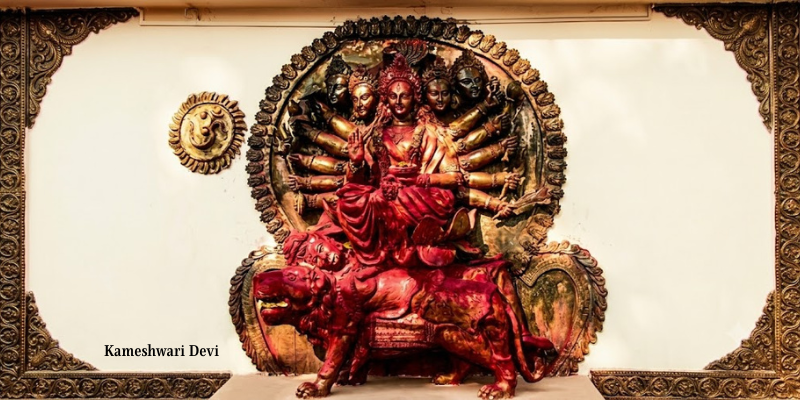
This particular festivity is no mere isolated affair; it forms an essential part of the philosophy of Indian mythology. It beautifully serves as the intermediary point between primitive animism and fertility cultism and mainstream highly developed Hinduism.
- The Supremacy of Shakti: n the earlier Vedic period, there was much emphasis on gods from the heavens such as Indra and Agni. However, with Tantric and Puranic mythology, came the Mother Goddess who took her rightful place as the very centre of the universe. This festival symbolizes the final scripture stating that the supremacy of Shakti (energy), without which Shiva (consciousness) is just a dead body (Shava).
- The Mythical Allusion to Universal Birth: The mythological significance of this time period in the Brahmputra river lies in its iron-rich and reddish nature, which represents the sacred blood of the Goddess. This is an awe-inspiring allusion to the tumultuous but beautiful and ultimately necessary act of birth, creation, and cosmic expansion.
- Kameshwari – The Fulfiller of Desires: At this place, the Goddess is referred to as Kameshwari, the Goddess of Desire. As per mythology, it was here that Shiva and Sati had their deepest secrets of love and romance. Therefore, the Goddess is paradoxically both the root of all our desires, as well as the divine mother who liberates us with her gift of Moksha.
Importance of Ambubachi in Hinduism
The importance of this festival transcends its rituals by far and constitutes a deep psychological, social, and spiritual paradigm shift that takes place within the mindset of Hinduism.
- The Empowerment of Women: Amid a culture that has often looked at the biological aspects of women with misunderstanding, the importance of this festival is unparalleled and unshakable. Through scriptural command, it demands that the process of reproduction of a woman is neither an impure aspect nor shameful, but rather the very manifestation of divine power. Thus, the female body has been consecrated as a holy temple of God.
- The Necessity of Rejuvenation: This practice informs man about the crucial spiritual significance of rest. Just as the earth needs a break from the harsh and violent process of ploughing to renew itself, humans need to take breaks in life where they can rest in stillness, fast from all material pleasures, and withdraw themselves.
- The Interdependence of Opposing Cosmic Forces: In this celebration, the basic Tantric concept—that of the integration of the divine and profane, pure and impure—is wonderfully portrayed. Humans are made aware of the reality of the divine present in nature through the celebration, thus shattering the false dichotomy created by ignorance.
- The Gift of Ultimate Liberation: By taking part in this ritualistic practice, one does not simply ask for money and other worldly possessions but, rather, makes it the key to achieving spiritual liberation. It symbolizes the embrace of the Mother, reminding us that we are forever cradled and nurtured by the cosmic mother.
A Ocean of Devotion: The Ambubachi Mela
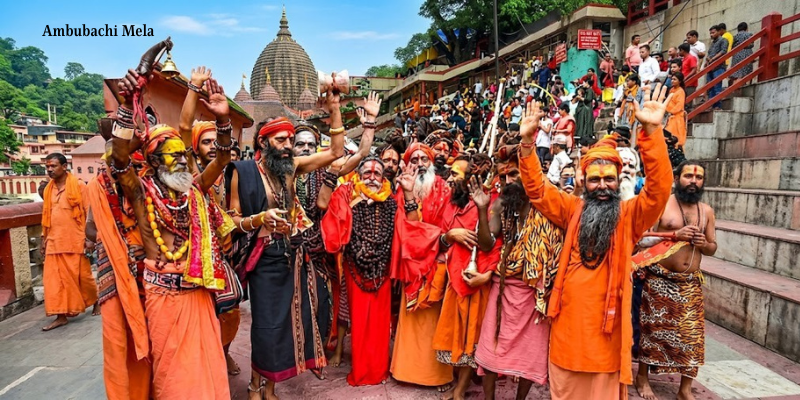
To experience firsthand this festival means to immerse oneself in an amazing array of devotion, mysticism, and human perseverance. During these days of intense spiritual fervour, the quiet temple complex and the bustling urban environment of Guwahati evolve into a lively and throbbing sea of spirituality. The Ambubachi Mela is a festival like no other in the world.
- The Congregation of Mystics: Tens of thousands of mystics flood into the city. Visitors will come across Naga Sadhus smeared with white holy ashes from cremation grounds, Aghoris in deep meditation, wandering Bauls of Bengal singing folk songs with their single-string Ektaras, and mysterious Tantriks wearing brilliant red saris.
- The Crimson Tide: Red is undoubtedly the colour of the Mela. It represents powerful fertility and the power of the flames generated by the Goddess. Everything from the whole temple complex to the devotees are wrapped in red colour. Millions of devoted people apply sindoor (red vermillion) on their foreheads, parting of their hair, and on their faces.
- The Trance of Worshipers: With the overpowering smell of burning camphor, thick smoke of incense, and the constant chanting of old Tantric Mantras, the entire atmosphere becomes one which mesmerizes everybody to a trance. Rhythmic beating of drums along with conch sounds create an even more mesmerizing effect of the entire atmosphere.
- The Test of Endurance: Devotees readily endure the rains and humidity of monsoon season, standing in long queues and sleeping on the wet pavements and temple courtyards of millions of pilgrims. All this pain and discomfort endured for just a few seconds of looking into the temple sanctorum on the fourth day is amazing.
Where to Stay During Ambubachi at Guwahati?
During this period, Guwahati turns out to be a destination of many pilgrims and thus choosing an appropriate place to stay is not that easy. There are places available in Guwahati for all kinds of people who are looking for sanctuary irrespective of whether it is ascetic or luxurious one.
Luxury Retreats (For Comfort and Rejuvenation)
- Vivanta Guwahati: This luxury hotel is strategically situated near the GS road and offers a place of relaxation from the hustle-bustle of the festival.
- Key Features: Spa treatments of the finest quality for relaxing aching muscles, delicious fine Assamese cuisine at the hotel’s own restaurant, and exemplary hospitality to ensure a relaxed stay away from the noise of the Kamakhya Temple.
- Radisson Blu Hotel Guwahati: This hotel is slightly far from the chaos of the city center yet easily accessible to the highway connecting to the Nilachal Hills.
- Key Features: Stunning views of the Deepor Beel lake, a big pool for refreshing swim sessions, and ultra-comfortable soundproof rooms for meditation.
Comfort in Mid-Range (Optimum Balance Between Expense and Ease)
- Hotel Rajmahal: Extremely popular place situated near the Paltan Bazaar railway station, making it extremely convenient for tourists coming by train.
- Key Features: Exclusive vegetarian food facilities (that go hand-in-hand with the fasting ritual of the festival), air-conditioned rooms, and easy means of transportation leading to the temple area.
- Pragati Manor: Situated at the famous GS Road, it provides the right mix of modern luxury and the traditional hospitality of Assam.
- Key Features: Good food facilities within the hotel itself, proximity to shopping complexes, and luxurious rooms at economical prices.
Budget Stay Options (For the Humble Pilgrim)
- Hotel Mayur: Situated just across from the Guwahati Railway Station on Paltan Bazaar. One of the oldest and the most reliable budget accommodation choices for pilgrims.
- Key Features: Super value-for-money, high accessibility and basic but decent rooms; constantly filled with other pilgrims and great for a sense of community.
- Ginger Guwahati: A dependable budget hotel offered by the famous Tata Group.
- Key Features: Consistently clean, equipped with modern facilities such as internet and air conditioning, and extremely safe at an excellent cost-effectiveness ratio.
The Spiritual Souvenirs of Ambubachi at Guwahati
No religious trip is ever deemed complete without some physical reminders to carry home from the sacred trip. These can be found during the celebrations in the markets of the city, particularly on the streets that lead up to the temple.
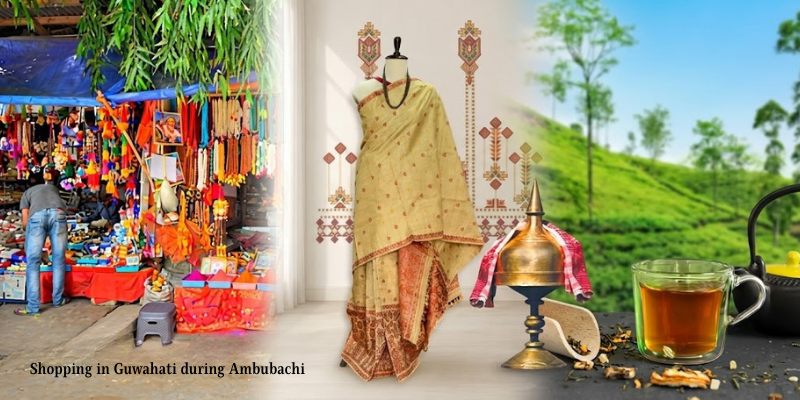
- Sacred Tantric Artifacts: The stalls present on the hills of Nilachal are known for their use in Tantra Sadhana. Amongst many things, one can find unique Rudraksha beads, Sphatik (crystal) malas, copper yantras, and Kamakhya Sindoor (vermillion), which is considered sacred all over India.
- Mekhela Chador (Assamese Silk): It is an international reputation of Assam for its indigenous silk. Golden Muga silk, Eri (Peace silk) and Pat are some varieties available in this region. A visit to the Government emporiums located at Pan Bazaar and Fancy Bazaar to purchase a two-piece traditional Mekhela Chador would be highly recommended.
- Authentic Assam Tea: Known worldwide for its strong malty taste, the Assam tea leaves can be purchased at specialized tea boutiques located in the city centre. Buy first or second flush Orthodox tea directly from the large-scale tea gardens of upper Assam.
- Bell Metal & Brass Crafts: The traditional artisans of Assam prepare unique utensils made out of bell metal or kann (Kanh) and brass (Pitol). Xorai (an offering tray placed on stand made out of bell metal) or Bota (a small water vessel made out of brass) could be interesting items to take back as souvenirs.
Final Reflections: Surrendering to the Mother
To experience, take part in, or even reflect upon the festival of Ambubachi Festival requires one to make an abrupt and irrevocable transition within one’s spiritual awareness. One must shed oneself of all superficial social conditioning and look unflinchingly at the naked and powerful essence of cosmic creation. It means bowing one’s head to Earth not simply as a barren stone floating in the emptiness of outer space, but as a pulsating life force nurturing all its creations.
In the midst of these cleansing showers, and amidst millions of tear-filled eyes, as devotees leave the holy hills with the sacred red piece of cloth wrapped around their heart, the eternal message of this festival echoes in the air. The Ambubachi Festival is a timeless, divine message that man must worship nature, accept nature for what it really is, and not escape or deny it. It demands that one should awaken one’s own internal fire to celebrate the infinite grace of the Divine Mother, in all her fierce and graceful form, forever accepting that in the eternal mystery of the Mother’s womb, lies infinite light, the entire universe’s eternal light.