What is Akshaya Tritiya? Significance, Stories, Rituals & Celebrations in India
In the sacred rhythm of the Indian spiritual calendar, there are a few days that match the profound purity and cosmic promise. Akshaya Tritiya, which occurs on the third day of the bright half of the lunar cycle (Shukla Paksha Tritiya) in the sacred month of Vaisakha, is celebrated in both Hinduism and Jainism as a gateway to eternity.
The term “Akshaya” means “that which never diminishes, decays, or perishes”. The spiritual and material seeds sown on this day, in any form, are believed to bear fruit in abundance. It is uniquely celebrated as a Swayam Siddha Muhurta, a day of such inherent sacredness that no astrological guidance is needed to begin a noble endeavour.
The Cosmic and Astrological Significance
Astrologically, Akshaya Tritiya is considered a day of supreme cosmic equilibrium. It is believed that on this day, both the Sun (symbolising the soul) and the Moon (symbolising the mind) are in their exalted positions, radiating at their brightest.
Spiritually, it is a day that reminds us that true wealth is not only our gold accumulated but also our spiritual wealth (Punya) accumulated. The scriptures tell us that Japa (chanting), Yajna (fire sacrifice), and most importantly, Dana (charity) done on this day attach themselves to the soul forever, never diminishing.
- Sanatana Dharma: The Divine Leelas of Akshaya Tritiya
In Hinduism, Akshaya Tritiya is the confluence of many divine descents and historical milestones. It is the day on which the veil between the mortal world and the divine world is at its thinnest.
- The Descent of Mother Ganga: As an answer to the unwavering penance of King Bhagiratha, the holy river Ganges descended from the heavenly realms to the Earth on this day, conferring purity and liberation to the souls of his ancestors and all of humanity.
- Appearance of Lord Parashurama: Lord Vishnu descended to the Earth in the incarnation of Lord Parashurama, the fiery warrior sage, on this day. His mission was to restore balance in the world, free the Earth from tyrannical rulers, and reinstate Dharma.
- The Dawn of Treta-Yuga: The wheel of time turned, and the official beginning of Treta-Yuga—the era in which great sacrifices would take place, and Lord Rama would manifest himself on Earth—was ushered in on this day.
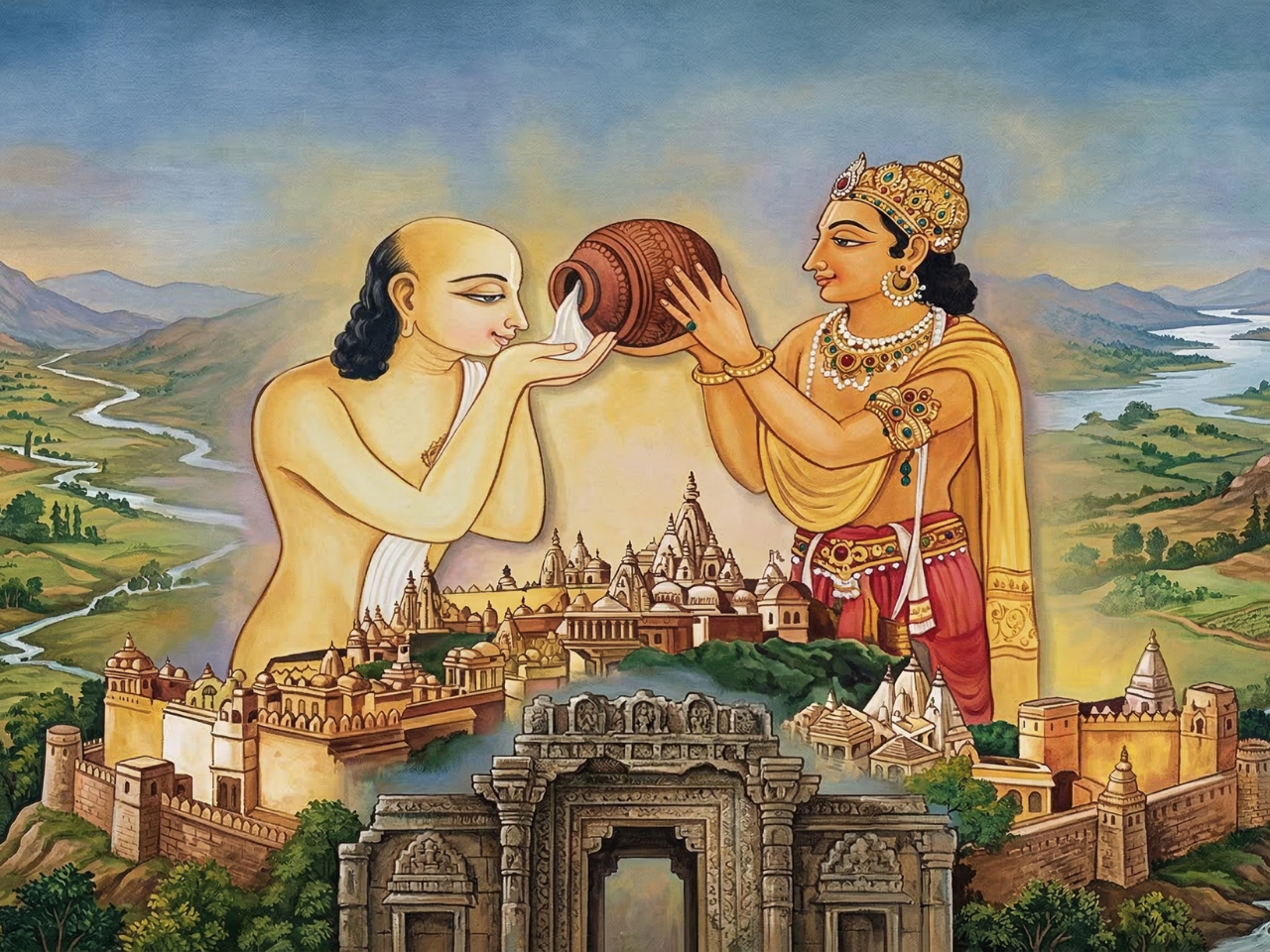
- Sudama’s Visit to Dwarka: The poor but pure-hearted Brahmin, Sudama, visited his childhood friend, Lord Krishna. As an offering to his Lord, Sudama timidly offered a handful of simple beaten rice. Lord of the Universe consumed it with immense love, and Lord Krishna showered him with wealth in abundance.
- The Gift of the Akshaya Patra: The Pandavas, in their long stay in the forest, were blessed by the Sun God (Surya) with the divine Akshaya Patra, which ensured that there was no dearth of food for them or their guests.
- The Writing of the Mahabharata: The great sage Vyasadeva began dictating the epic Mahabharata to Lord Ganesha on this day, spreading spiritual wisdom among humanity.
- The Kanakadhara Stotram: The young sage Adi Shankaracharya, inspired by the selfless act of a poor woman who offered a dry amla fruit, composed this lovely hymn. Goddess Lakshmi, pleased with his devotion, blessed the poor woman’s abode with golden amlas.
- Appearance of Goddess Annapurna: Goddess Annapurna Devi appeared to ensure that no being in the universe was deprived of food.
Kubera’s Elevation: Kubera, by his intense devotion to Lord Shiva, was elevated to become the treasurer of the gods.
Jainism: The Triumph of Tapasya (Austerity)
In the context of the Jain faith, Akshaya Tritiya is of immense historical and spiritual importance, focusing on the highest virtues of renunciation and penance (Tapasya).
- The Fast of Lord Adinath: The day is inextricably connected with the first Tirthankara, Lord Rishabhanatha, or Lord Adinath. Lord Rishabhanatha renounced his kingdom and other worldly pleasures, going into a rigorous ascetic fast for 400 days without food or water.
- The Breaking of the Fast (Parana): Since it was not customary in those days to offer charity to monks, he was offered gold and jewels, which he silently declined. Finally, on the day of Akshaya Tritiya, King Shreyansa of Hastinapur, recalling his past lives, realised how he could offer food to a Jain monk. He humbly offered Lord Adinath pure sugarcane juice (Ikshu-rasa).
- The Tradition of Varshi Tapa: Lord Adinath, by accepting sugarcane juice, broke his fast. Today, devout Jains commemorate this momentous day by performing the tradition of Varshi Tapa, a rigorous fast for one year, by abstaining from food every alternate day. This monumental spiritual endeavour is concluded by breaking fast with sugarcane juice on the day of Akshaya Tritiya, as was done by the great Lord Adinath.
Rituals followed in Akshaya Tritiya
Sacred Celebrations Across Bharat
In the vast and sacred landscape of Bharat, Akshaya Tritiya is not just an occasion marked on the calendar; rather, it is an experience of the divine grace that permeates the atmosphere.
The Himalayan Awakening: Badrinath, Uttarakhand
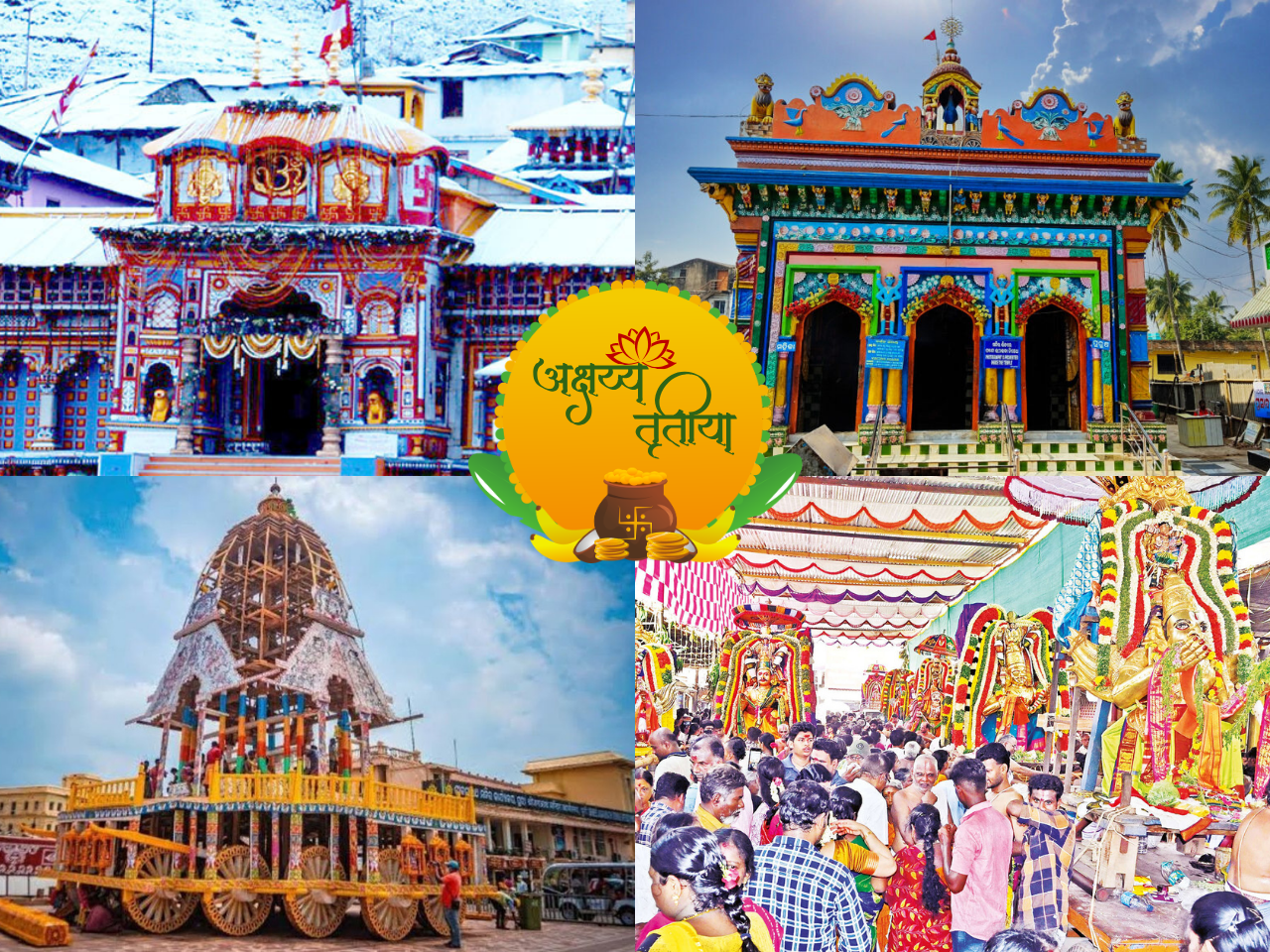
In the high reaches of the Garhwal Himalayas, the winter months are severe and unkind. The sacred portals (Kapat) of the Badrinath Temple are closed for the next six months, during which time it is believed that the worship of Lord Badri Vishal is performed by the Celestial Beings (Devas).
- The Opening of the Kapat: On the morning of Akshaya Tritiya, the temple doors are unlocked in the midst of the chants of Vedic hymns and the blowing of conch shells.
- The Akhand Jyoti: The first of the great blessings for the thousands of shivering, devout pilgrims assembled outside the temple is the Darshan of the Akhand Jyoti, the eternal oil lamp that burns throughout the six months of winter isolation. This marks the beginning of the joyous pilgrimage of the Char Dham Yatra.
The Unveiling of the Fierce Lord: Simhachalam, Andhra Pradesh
At the temple of Sri Varaha Lakshmi Narasimha Swamy near Visakhapatnam, a spectacular and once-in-a-lifetime spiritual experience occurs.
- The Cooling Sandalwood: Narasimha Swamy is the half-man-half-lion incarnation of Lord Vishnu. He was born in a state of fierce anger (Ugra). To calm his divine rage, his idol is covered with a thick layer of cooling sandalwood paste (Chandan) for 364 days of the year, making him look like a plain Shivalinga without any idolatry.
- Nijarupa Darshanam: On the special day of Akshaya Tritiya, the hard sandalwood paste is removed from the idol. Millions of pilgrims throng the temple to catch a glimpse of the rarest sight—the Nijarupa Darshanam—the brief appearance of the majestic form of the Lord before it is covered with fresh sandalwood paste later that night.
The Divine Cooling of Braj Bhumi: Vrindavan, Uttar Pradesh
In Braj, the spiritual hub where Lord Krishna displayed his divine leelas (plays) in his childhood, the scorching heat of summer begins to set in around Akshaya Tritiya.
- Charan Darshan at Banke Bihari: All through the year, the lotus feet of the beloved deity Sri Banke Bihari remain hidden under a heap of ornate dresses and fragrant flowers. But on Akshaya Tritiya, the Lord bestows his highest mercy. The dresses are adjusted to allow the darshan of his holy feet, also known as Charan Darshan.
- Chandan Yatra: To save the deities from the scorching heat of summer, the deities in Vrindavan temples are decked up in dresses of pure sandalwood paste.
The Coastal Rhythms of Jagannath: Puri, Odisha
In the ancient temple city of Puri, Akshaya Tritiya sets into motion the supreme spiritual scene of the state.
- The First Cut for the Chariots: The world-famous Rath Yatra (Festival of Chariots) calls for the preparation of three massive intricate wooden chariots. The holy ritual commences on this precise day. The temple priests consecrate the first axes, and the first holy logs are ritually cut outside the Jagannath Temple to seek divine blessings for a flawless festival.
- Chandan Yatra (Water Pastimes): This day also marks the beginning of the 21-day-long Chandan Yatra. The representative deities of Lord Jagannath (Utsava Murtis) are taken in a grand procession to the sacred lake of Narendra Sarovar. There, heavily anointed with sandalwood paste, these deities are placed on beautifully decorated swan-shaped boats (Chapa) to enjoy boat rides.
The Sweet Grace of Kshira-Chora: Remuna, Odisha
Just a few hours away from Puri, in a town called Remuna, is the temple of Kshira-Chora Gopinath (the Lord who stole sweet milk).
- The Chandan Besha: Here, the deity of Lord Krishna is completely covered in a paste made of sandalwood, camphor, and musk (Chandan Besha).
- The Amruta Keli Offering: Thousands congregate to relish the legendary Amruta Keli—a rich, sweet, and condensed milk product flavoured with cream, sugar, and raisins. This is the same prasad that the Lord stole and hid in his garments because of his sheer love for his great devotee, Madhavendra Puri.
The Commercial and Cultural Renewal: West Bengal & Maharashtra
While the temples pulse with devotion, the societal and familial fabric of Bharat is also renewed.
- Hal Khata in Bengal: For the traditional Bengal merchant and jeweller, this is the start of the new financial year. Shop owners will clean their shops, decorate them with flowers, and carry new account books (Hal Khata) to the temples of Lord Ganesha and Goddess Lakshmi. These will be marked with auspicious Swastik symbols in vermilion (Sindoor), and customers will be served sweets in the spirit of the indestructible relationship of trust and prosperity.
- Haldi-Kumkum and Ancestral Water in Maharashtra: Married women celebrate this day by conducting Haldi-Kumkum events, exchanging turmeric, vermilion, and sprouted gram, and offering prayers for the imperishable health of their families. Also, since this is the season of peak summer, families donate earthen pitchers (Ghats) containing cold water, melon, and sweets to Brahmins. This act of charity is performed in the name of the Pitrus (ancestors) so that the souls of the deceased remain cool and satisfied.
The Southern Processions: Kumbakonam, Tamil Nadu
In the deep south, the temple town of Kumbakonam transforms into a kaleidoscope of processions.
- The 12 Garuda Sevas: In an incredible demonstration of communal harmony and devotion, twelve different Utsavamurtis (processional deities) from various prominent Vishnu temples in the town are taken out at the same time. Riding their golden eagle mount (Garuda Vahana), these deities are taken out in procession, accompanied by the rhythmic recitation of the Divya Prabhandham (sacred Tamil hymns) and the beating of the temple drums.
The True Essence of “Akshaya”
Although modern times have seen the celebration of Akshaya Tritiya become highly commercialised and associated with the purchase of gold, the spiritual significance of the day demands that we reach for something much higher and deeper in the realm of wealth creation. The true essence of Akshaya is the love that we share, the charity that we provide, the mantras that we chant, and the devotion that we nurture within our hearts. Through the free and selfless giving of what we have, whether it is food, knowledge, or love, we align ourselves with the universal principle of abundance, keeping the light within us eternal and unspoiled.
About Infinity Heights –
Infinity Heights (www.infinityheights.in) is a premium residential development in Guwahati, thoughtfully designed for modern families seeking space, comfort, and a refined lifestyle. Strategically located in one of the city’s fast-growing residential corridors, the project combines seamless connectivity with a peaceful, elevated living environment. Built to meet the aspirations of today’s homebuyers, Infinity Heights offers well-planned, spacious apartments within a secure gated community.
The development focuses on holistic living, featuring contemporary architecture, ample open spaces, and lifestyle-driven amenities that promote well-being, convenience, and community interaction. With proximity to key commercial hubs, educational institutions, healthcare facilities, and major transit routes, Infinity Heights ensures that residents enjoy both accessibility and tranquillity. The project reflects the evolving real estate landscape of Guwahati, where quality construction, RERA compliance, and future-ready infrastructure are becoming essential benchmarks. Positioned as a smart investment opportunity, Infinity Heights aligns with the city’s rapid growth and rising property demand—making it an ideal choice for both end-users and long-term investors looking to be part of Guwahati’s promising future.
Experience the Infinity Heights lifestyle. Follow our journey on Facebook, Instagram, and LinkedIn, or visit us on Google Business.